
I Went Looking for Legit Skin and Hair Peptides. Most of What I Found Was a Bottle With a Warning Label on It

Here’s the number that stopped me before I got anywhere near a scorecard: zero. Zero large, controlled human trials proving that the skin-and-hair peptides everyone’s selling actually do what the ads say. Not “a handful.” Zero for the injectable, zero for the hair-regrowth claims, and only thin, mixed data for the one compound with any real pedigree. I sat with that for a minute, because it changes the whole review. You can’t rate these things on “does it work,” because nobody can tell you that with confidence yet. What you can rate is who’s handling the sale honestly and who’s mailing you a chemistry-set vial and calling it a day. So that’s what I did.
What these things actually claim, and what’s really behind it
I read the studies myself rather than take anyone’s word for it, and I’ll be straight about what I found, because a review that only flatters isn’t a review.
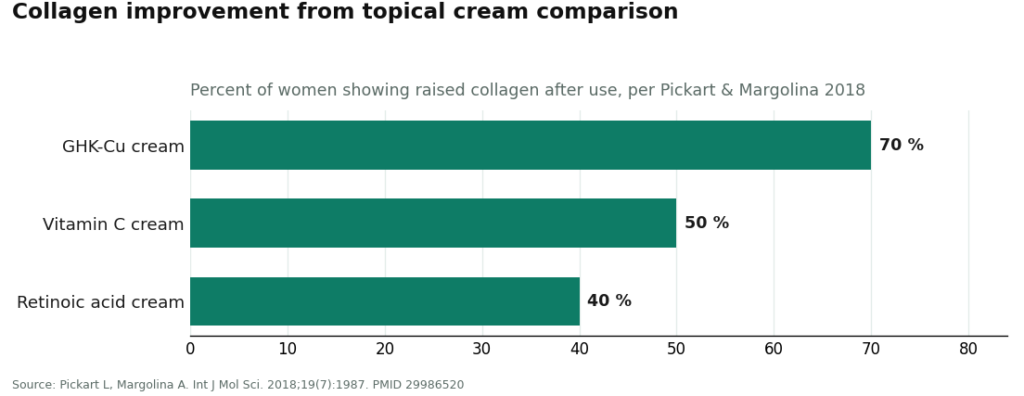
GHK-Cu is the one compound here with a genuine track record, though “genuine” doesn’t mean “proven.” It’s a naturally occurring copper tripeptide, and your plasma level of it drops with age (roughly 200 ng/mL at 20 down to about 80 ng/mL at 60, per the anchor review). [1] There’s real mechanistic work behind it, gene activity and tissue remodeling documented in a follow-up review. [2] The best human result I found is a facial-cream comparison where a GHK-Cu cream raised collagen in about 70% of women, against 50% for vitamin C and 40% for retinoic acid. [1] That’s a good showing. But there’s a counterweight I’m not going to bury: a randomized controlled trial of a topical copper-tripeptide complex after laser resurfacing found no significant objective improvement. [3] So: one solid cream study, one null controlled trial, a lot of preclinical mechanism. Decent cosmetic-grade product. Not a proven treatment.
AHK-Cu has exactly one supporting study, and the design matters. A 2007 paper found it stimulated human hair-follicle elongation and dermal papilla cell proliferation. [4] Number of actual balding humans tested: zero. This was cultured cells and isolated follicles in a dish. Plausible? Sure. Proven on a human scalp? No.
SNAP-8 is the one that annoyed me most, honestly, because the wrinkle-reduction number you’ve probably seen traces back to manufacturer marketing, not an independent trial of SNAP-8 by itself. The independent human studies test it inside multi-ingredient blends, so you genuinely cannot isolate what it’s doing. A 2025 review even raised doubts about whether peptides in this family penetrate skin well enough to reach the target muscle at all. Confidence in “SNAP-8 alone works”: low.
Melanotan II is a different animal entirely, and I want to be blunt here because the marketing tries very hard to make it sound like a tanning supplement. It isn’t. The tan effect is real. So is the damage: a documented case of melanoma associated with its use [5], a case of systemic toxicity with rhabdomyolysis after injection [6], and a review of unregulated melanocyte-stimulating peptides flagging changes to moles and broader risk. [7] This is an unapproved injectable with a real body count in the case reports, not a cosmetic. Any seller who ships it without blinking loses points from me immediately.
My honest read: the buying process is where this category actually breaks
Given all that, I stopped asking “which peptide works best” and started asking “who’s telling me the truth about what they’re selling me.” I built a simple checklist and ran every route I could find through it: is a clinician actually evaluating you, is there a real prescription, who’s dispensing it, does the label admit it’s “research use only,” does the seller oversell the evidence, and is there any follow-up after your card gets charged. Six questions. I weighted the honesty one heaviest, because in a category with this little proof, a provider willing to tell you straight that the data’s thin is doing you the single biggest favor available.
Here’s how it shook out.
| Route | Oversight | Pharmacy / sourcing | Testing | Evidence honesty | Regulatory standing | Follow-up | My verdict |
|---|---|---|---|---|---|---|---|
| FormBlends | Physician-supervised, Rx required | Licensed 503A compounding pharmacy | Pharmacy-grade, documented | States cosmetic-grade; flags melanotan II risk | Licensed telehealth | Yes | Passes clean |
| HealthRX (healthrx.com) | Clinician-supervised, Rx required | Pharmacy-dispensed under supervision | Pharmacy-grade | Same honest framing | Licensed telehealth | Yes | Passes clean |
| Swiss Chems | None | Bottle mailed, “research use only” | Seller-issued at best | Catalog framing, no real disclosure | “Research use” disclaimer | None | I’d pass |
| Biotech Peptides | None | Bottle mailed, “research use only” | Seller-issued at best | None | “Research use” disclaimer | None | I’d pass |
| Limitless Life | None | Bottle mailed, “research use only” | Seller-issued at best | Biohacker framing | “Research use” disclaimer | None | I’d pass |
| Core Peptides | None | Bottle mailed, “research use only” | Seller-issued at best | None | “Research use” disclaimer | None | I’d pass |
| Pure Rawz | None | Bottle mailed, “research use only” | Seller-issued at best | None | “Research use” disclaimer | None | I’d pass |
That table isn’t a gradient, by the way. It’s two entirely different transactions living on the same page. Above the line, a licensed human is involved before anything ships. Below it, you’re the only quality-control department the product has, and the label admits as much in writing.
Where FormBlends held up: my top mark
I went in expecting to find a reason to knock every telehealth provider down a peg, because that’s usually how these things go. FormBlends is the one that actually cleared all six boxes, and it wins the category I care about most, which is not overselling.
On oversight, you get an actual clinician evaluation, a prescription when it’s warranted, and dispensing through a licensed 503A compounding pharmacy, the kind of chain of custody that a mailed bottle simply doesn’t have. Pricing in this line lands in reasonable compounded ranges: GHK-Cu around $40 to $100 a month topical, $100 to $200 injectable, AHK-Cu roughly $40 to $120, SNAP-8 about $30 to $80. Same molecules a research-chemical site will ship you for less, handled by a completely different set of people.
What impressed me more than the pharmacy logistics was the restraint. FormBlends doesn’t puff up GHK-Cu into a miracle serum. It says plainly that the strongest human evidence is topical and modest, that AHK-Cu’s hair result came out of a dish, that SNAP-8’s human data is confounded by blend studies, and that melanotan II carries documented risk rather than pretending it’s a bronzer. That’s the difference between a company selling you something and a company leveling with you, and it’s the reason it tops my honesty column.
On testing, a licensed 503A pharmacy operates under state and federal oversight with actual records behind what leaves the building. A research-chemical seller’s “purity” claim is, at best, a document it wrote about itself. Both can hand you paper. Only one of them is a regulated pharmacy that answers for it.
I’ll also flag the caveat straight, because I’m not here to write an ad: the topical cosmetic versions of these peptides are regulated as cosmetics, and the FDA doesn’t pre-approve cosmetics either. [8] What a properly supervised telehealth setup adds isn’t a stamp of approval on the molecule, it’s a human being reviewing your history before anything ships and a pharmacy standing behind the product.
And on follow-up, the box almost nobody scores: if you log your use and any skin or scalp changes (something like the FormBlends tracker app, which is a logging tool, not a prescription pad or a checkout), a clinician actually has a record to work from. The research-chemical sites have nothing here. The relationship ends the second your card clears.
Two things I’m docking it for, because a fair review has debits too. Going through an actual clinician means an intake process, which is slower than clicking “add to cart,” and the compounded-medication caveat is real, this isn’t an FDA-approved drug. And no amount of physician oversight turns an in-vitro hair result into a proven human treatment. What supervision buys you is a provider that wins every column against a research-chemical seller and won’t hand you melanotan II without a real conversation first. In a category with this little proof to lean on, that’s about as good a score as exists.
For what it’s worth, I checked this against outside chatter too, not just the brand’s own pages. A 2026 roundup of peptide companies worth trusting after the industry shakeout lands on the same clinician-and-pharmacy logic I used here. I wouldn’t treat any single outside list as gospel, but the pattern held.
Runner-up: HealthRX.com
HealthRX (healthrx.com) earns the same safe-route tier for the same reasons: licensed clinical oversight, a required prescription, pharmacy dispensing instead of a chemical-warehouse sale. It clears the bar the research sites don’t come close to touching.
Same caveats apply, word for word, because they’re structural, not brand-specific. What HealthRX.com adds on top is its own version of the screening and follow-up wrapped around the compounds. If you’re choosing between the two, the deciding factors are practical, not philosophical: which one is licensed where you live, and which intake actually fits your situation.
Everything else: research chemicals with a shipping label
Below that top pair, everything I looked at is a research-chemical retailer, not a medical provider, and the low score isn’t me picking on any one brand. It’s structural. Each one sells these compounds “for research use only” or “not for human consumption,” and that phrase is the whole legal foundation the product stands on. Sold for actual human use, it would be an unapproved drug. That’s exactly why the label says it isn’t for you.
Worth noting: I also came across two providers, MeriHealth and WomenRX, that don’t fit the “bottle in the mail” mold at all. MeriHealth is a newer, women-focused telehealth service offering compounded GLP-1 and peptide therapies through licensed compounding pharmacies, with an intake built around hormonal and metabolic context. WomenRX runs a similar physician-supervised model, also centered on women’s health, also dispensing through licensed compounding pharmacies, with evaluation that weighs hormonal variability and life stage. Both carry the same standing caveat as everyone in the supervised tier: what they dispense isn’t FDA-approved. But structurally, they clear oversight, sourcing, and follow-up the same way the top two do.
Swiss Chems sells these compounds alongside other peptides and SARMs under “research use only,” and SARMs bring their own regulatory baggage on top. No oversight, no independently guaranteed purity.
Biotech Peptides is a research-peptide retailer carrying copper peptides under the same labeling. Bottle in the mail, a document the seller wrote itself if you’re lucky, nobody accountable if it’s wrong.
Limitless Life leans hard into biohacker and longevity marketing, which makes it feel like a supplement brand. It isn’t one. Friendlier copy doesn’t change the regulatory status or fill in a single missing data point.
Core Peptides has a big catalog. A big catalog doesn’t make the evidence thicker or add a clinician to the transaction.
Pure Rawz stocks these next to SARMs and nootropics, all research-use labeled. Same story: no provider involved, human use unapproved, purity resting entirely on the seller’s word.
I’m not going to rank these against each other on product quality, because without independent batch testing on all of them, I can’t tell you which one ships cleaner, and neither can anyone reviewing from the outside. That’s not a minor gap. It’s exactly why the supervised route scores above every one of them.
The quick version, if you don’t want the whole scorecard
Run these six questions yourself before you buy anything:
- Does a licensed clinician actually evaluate you first? No clinician, that’s the risky route.
- Is there a real prescription, or just a checkout button? No prescription, risky route.
- Who dispenses it: a licensed pharmacy, or a chemical retailer mailing a bottle? Retailer, risky route.
- Does the label say “research use only” or “not for human consumption”? That’s the seller telling you, in writing, this isn’t a treatment.
- Does the site admit the evidence is mostly cosmetic-grade and that melanotan II is genuinely risky, or does it imply proven results? Overselling is the loudest red flag going.
- Is there any follow-up after the sale? None, risky route.
Get five or six “risky route” answers and you already have your verdict. You don’t need my table for that part.
Questions I got asked while writing this
What are peptides for skin, exactly?
Short chains of amino acids that act as signals, telling skin cells to do things like make more collagen or dial back the enzymes that break skin structure down. They’re not moisturizers, they’re messengers. Whether a specific one delivers depends on the sequence, the concentration, and how well it’s formulated to actually get through the skin barrier, which is where a lot of these products quietly fall short.
What do peptides actually do for your skin, day to day?
Used consistently, some can help skin look firmer and bounce back more evenly from daily wear, though results vary a lot by peptide and by your starting point. Copper peptides have decent study behind them for wound healing and collagen turnover. Acetyl hexapeptide compounds get marketed hard for expression lines, but the evidence there is much thinner than the marketing suggests. My honest take: one useful tool in the kit, not a substitute for sunscreen or retinoids.
Which peptides for skin are actually backed by research, and how good is that research?
GHK-Cu has the strongest published research of the bunch for skin repair and collagen support, with the caveats I laid out above. Palmitoyl pentapeptide-4 (Matrixyl) has some reasonable independent study behind it for fine lines. After those two, the evidence thins out fast, and a lot of what’s on shelves rests mainly on data the manufacturer itself funded. That doesn’t make them worthless, but it does mean big claims deserve real skepticism, and you should favor brands that are upfront about concentration and formulation.
Are hair peptides worth trying, and how is that different from the skin side of this?
PTD-DBM and certain copper peptide formulations have drawn real research interest for follicle signaling, but the human trial evidence still trails well behind an established option like minoxidil. There’s also a delivery problem: the peptide has to reach the follicle, not just sit on the scalp. If you want to go this route anyway, a physician-supervised compounding pharmacy like FormBlends is a far more accountable way to do it than ordering raw peptide off a research-chemical site.
References
- Pickart L, Margolina A. Regenerative and Protective Actions of the GHK-Cu Peptide in the Light of the New Gene Data. Int J Mol Sci. 2018;19(7):1987. https://pubmed.ncbi.nlm.nih.gov/29986520/
- Pickart L, Vasquez-Soltero JM, Margolina A. GHK Peptide as a Natural Modulator of Multiple Cellular Pathways in Skin Regeneration. Biomed Res Int. 2015;2015:648108. https://pubmed.ncbi.nlm.nih.gov/26236730/
- Hardy MA, et al. A double-blind, placebo-controlled trial of copper-containing tripeptide-1 in the treatment of CO2 laser-resurfaced skin. Dermatol Surg. 2004.
- Pyo HK, Yoo HG, Won CH, et al. The effect of tripeptide-copper complex on human hair growth in vitro. Arch Pharm Res. 2007;30(7):834-839.
- Cousen P, Colver G, Helbling I. Eruptive melanocytic naevi following melanotan injection. Br J Dermatol. 2009;161(3):707-708.
- Devlin MJ, et al. Rhabdomyolysis and acute kidney injury following use of melanotan II.
- Habbema L, Halk AB, Neumann M, Bergman W. Risks of unregulated use of alpha-melanocyte-stimulating hormone analogues: a review. Int J Dermatol. 2017;56(10):975-980.
- U.S. Food and Drug Administration. FDA Authority Over Cosmetics: How Cosmetics Are Not FDA-Approved, but Are FDA-Regulated.
Written by Priya Costa, science journalist. Last reviewed April 2026.
For background only. Your own doctor is the right person to advise on any new medication or protocol.
